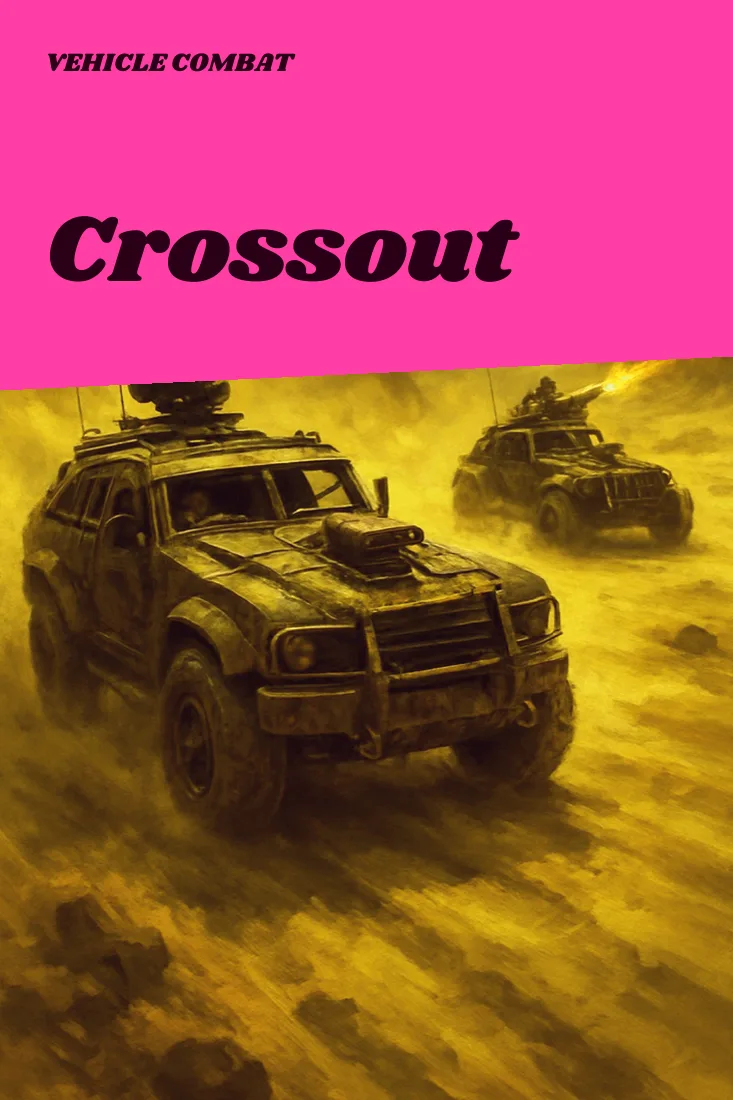
Crossout is developed by Targem Games and published by Gaijin Entertainment, and it is a free download for Windows PC, PlayStation 4 and 5, and Xbox One and Series X/S. There is a separate Crossout Mobile app for phones, but this review is about the PC and console game, which ran in open beta from 2017 and has since been refreshed with a remastered look: reworked lighting, landscapes, effects and dynamic water.
The premise is gloriously simple. The world has ended, the survivors drive armoured contraptions, and you build yours from parts. A cab, a frame, some wheels or tracks, a few guns, some plates of scrap. You can make something sensible, or you can make a six-wheeled cannon platform with a harpoon on the roof. The game lets you, then puts your creation in a match and shows you exactly how good an idea it was.
The garage is the real game
The vehicle editor is where Crossout shines. Parts snap onto a grid frame, and each part has weight, durability and a place in the physical model. Put your weapons too high and they get shot off first. Mount the engine at the back and a rear hit hurts. Pile on armour and your wheels struggle to carry it. The editor shows the numbers, but the lessons arrive in battle.
We spent nearly as much time building as fighting during our testing, and never regretted it. There is genuine design satisfaction in rebuilding a car three times until it finally survives a head-on duel. The game also lets you save several builds and swap between them, which encourages experimentation. If you have ever loved building blocks or model kits, this part alone justifies the download.
Battles, raids and the brawl rotation
The core mode is eight-against-eight team battles on compact maps, with objectives such as capturing a base or wiping out the enemy team. Matches are quick and loud, rarely lasting longer than a few minutes, and the physics of crashing two homemade trucks together never really gets old. Matchmaking uses each vehicle’s power score, the sum of its parts’ values, to keep fights roughly even.
Beyond that sit cooperative raids for four players against computer-controlled enemies, which are a gentler place to earn resources, and a rotating set of brawls that change the rules entirely, including a large battle royale. There is also an adventure mode with a looser structure. The variety keeps the week fresh, and the raids are a good place to test a build without letting down a team.
A player market with real character
Crossout has an in-game market where players trade parts and resources with each other at prices the community sets. Factions specialize in different styles of part, and resources earned through battles feed a crafting system that turns common components into better ones. The market makes the economy feel alive: prices move after updates, and a new weapon can reshape demand overnight.
For a free player, the market is both a gift and a puzzle. Patient traders can assemble strong parts without spending, but the system takes time to understand, and the best components are expensive in effort. We would advise new players to ignore it for the first week, learn what they enjoy driving, and only then start crafting toward specific parts.
What keeps it from the top spot
Crossout’s weakness is balance. Because builds are so open, certain weapon combinations dominate for a while after each update, and meeting the same overtuned design several matches in a row is tiresome. The power-score system keeps teams even on paper but cannot account for one player’s brilliant design against another’s sloppy one.
Newcomers can also find the first hours confusing, since the game layers factions, crafting, resources and market at once. Our fairness score reflects how long a free player waits for the parts they want. None of this spoils the fun, but it does mean Crossout rewards stubborn tinkerers more than casual visitors. If you enjoy problem-solving, these flaws become part of the challenge.
Your first seven days in Crossout
- Download from the official site or your console store, finish the opening tasks and learn the editor’s grid before touching the market.
- Rebuild your starter vehicle at least once, moving the guns lower and the armour forward, then compare how long it survives.
- Join four-player raids to earn resources and test designs without letting down a full team.
- Pick one faction whose parts suit your style and follow its upgrades instead of chasing every new weapon.
- Save two different builds by the weekend and switch between them depending on which mode is running.
Where the armour holds
- The best free vehicle editor we have used, with physics that judge every design.
- Quick, loud eight-against-eight battles that suit a short evening.
- A living player market where prices react to every update.
- The remastered lighting and dynamic water make the wasteland look much better.
Where it rattles
- Dominant weapon builds appear after updates and repeat until the next balance pass.
- Factions, crafting and the market arrive all at once for newcomers.
- The best parts take a long, patient stretch for players who never spend.
Who should report for duty in Crossout
Crossout is for players who would happily spend an hour in a garage to win one fight. It suits model makers, engineers at heart and anyone who loves the idea of a wasteland car show. Players who just want a fixed tank and a quick match may prefer Tanki Online.
After-action report on Crossout
Crossout is the most creative game on our desk and the purest expression of the builder’s fantasy. The balance wobbles, and the economy needs patience, but the moment your own ugly creation survives a fight it had no right to win is worth every frustrating rebuild. It sits second only because War Thunder is deeper as a war game; as a sandbox, nothing here beats it.