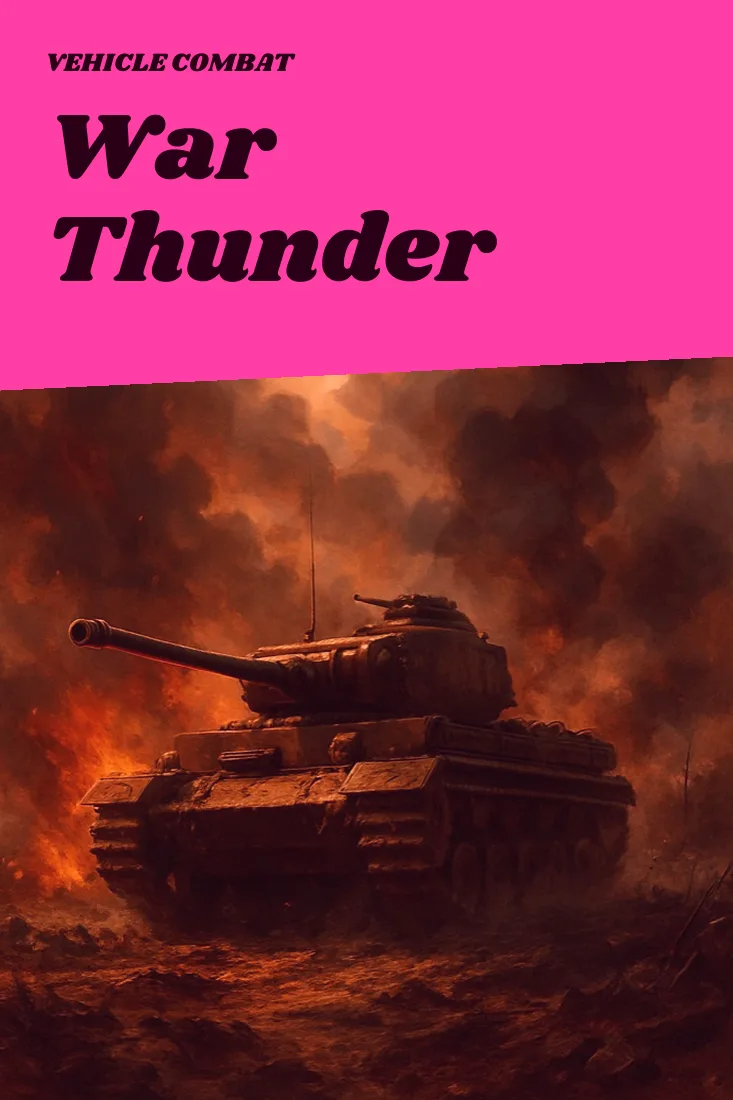
War Thunder is a free download for Windows, macOS and Linux, and it runs on PlayStation and Xbox too. That matters, because this is a large game that wants a proper install and a controller or mouse you trust. It has been in development at Gaijin Entertainment since its open beta in 2012 and was formally released in December 2016, and it has kept growing ever since: Gaijin now counts more than 2,500 vehicles across ground, air and sea.
We spent the longest stretch of our testing here, starting from a fresh account and working through several nations’ trees. The headline is simple. No other free game on our desk treats its machines with this much respect. A tank’s armour is modelled plate by plate, shells behave according to their type, and the difference between a good angle and a bad one is often the difference between driving home and watching the replay camera.
One battlefield, three ways to read it
Every match in War Thunder is played under one of three rule sets. Arcade battles are the friendly door in: markers over enemies, forgiving aim assistance and quick respawns with different vehicles. Realistic battles strip much of that away and make spotting, positioning and communication matter. Simulator battles go further still, with cockpit-only views for aircraft and almost nothing on the screen to help you. The same vehicle feels like three different machines depending on which you choose.
We recommend everyone starts in Arcade ground battles and stays there for the first few ranks. It teaches the maps, the basic shapes of enemy tanks and the rhythm of capture points without making every mistake fatal. Once you start wondering why a shell bounced off a plate you were sure was thin, you are ready for Realistic. Simulator is for a dedicated minority, and the game is honest about that.
Research trees that take seasons, not days
Progression runs through national technology trees, one for each of the ten nations Gaijin lists. You start at the first rank with interwar and early Second World War vehicles and research your way up towards modern armour and jet aircraft. Each vehicle you use earns research toward the next, and a trained crew makes a real difference to reload times and spotting. It is a slow, deliberate climb by design.
The early ranks pass quickly and pleasantly. The middle ranks are where the game sorts the curious from the impatient, because research slows and repair bills start to bite after a poor match. We found that sticking with one nation and one vehicle type for a few weeks is far more satisfying than spreading out. Play a nation you find interesting, not the one forum posts insist is strongest this month.
A damage model that makes you a better driver
What keeps us coming back is the way War Thunder handles hits. Gaijin describes its damage models as physically based, and in practice that means the game tracks where a round strikes, what it passes through and which crew members or modules it reaches. You can lose a gunner, a transmission or a fuel tank and limp on, or you can be knocked out instantly by a shell that found the ammunition rack.
The game teaches this through its replays and hit camera, and after a few dozen deaths you start to think like an armour designer. You angle your hull, hide your weak lower plate behind a rock and aim for the turret ring rather than the thickest steel. That learning is permanent and it carries from tree to tree. Few games make the player visibly smarter over time, and this one does.
Where the grind and the crowds bite
War Thunder is not without friction. At higher ranks, matches can feel swingy when one team collapses early, and losing a run of games drains both research and repair funds. The vehicle roster is vast enough that new players can feel lost in menus. And the sheer amount of historical detail means some battles are decided by knowledge the newcomer has simply not had time to collect yet.
Typical maps are built for 32 players in two teams, with some events reaching 64, and the larger battles can be chaotic in the best and worst senses. Aircraft joining ground battles adds tension, but being bombed from a sky you were not watching takes some getting used to. Our advice is to treat losses as lessons and keep sessions short when the matchmaking feels rough.
Your first seven days in War Thunder
- Install from the official site or your console store, then play the tutorial missions; they explain capture points and the basics of armour angles.
- Pick one nation’s ground tree and stay in Arcade battles at the first rank until the maps start to feel familiar.
- Watch the hit camera after every death and note where the shot came from; this habit pays off for months.
- Spend early research on crew training for your favourite tank before chasing the next vehicle in the line.
- Try one Realistic battle by the weekend, just to feel the difference, then return to Arcade without guilt.
Where the armour holds
- Historical tanks, aircraft and ships sharing the same battlefields in one coherent game.
- A damage model that explains every knockout and quietly teaches you better tactics.
- Three realism settings, so the game grows with your skill and patience.
- Cross-play across PC and both console families keeps queues full at any hour.
Where it rattles
- The middle ranks slow down sharply, and repair bills sting after a bad night.
- Menus and research screens can overwhelm a newcomer for the first week.
- Matches occasionally collapse early when one team loses its nerve.
Who should report for duty in War Thunder
War Thunder suits players who enjoy learning a system properly: history readers, model builders, flight-sim fans and anyone who wants their tank to feel like a real machine. It suits less well those who want instant action every evening without study or the occasional frustrating loss.
After-action report on War Thunder
This is the most complete free military game we know, and it deserves its place at the top of our list. The learning curve is steep and the middle ranks test your patience, but no other game here teaches you so much or rewards understanding so consistently. Install it, give it two honest weeks in Arcade, and you will know whether this is a hobby for the next few years.